

In Paris, Notre Dame will soon have a new set of stained glass windows by French artist Claire Tabouret, winner of a competition for their design—and winner of a certain amount of hate from opponents who are upset at the idea of replacing a set of windows installed in the 1860s by Eugène Viollet-le-Duc.

It’s a seriously ironic situation, given the controversy in his own time of Viollet-le-Duc’s work in ‘restoring’ the cathedral, which included installing a spire that had never existed, new statuary and, yes, new windows.


I’ve put quotation marks around ‘restoring,’ and I’ll do the same for ‘renovating’ and various other verbs used to describe work done on historic buildings, because there’s no real agreement on what they mean, or where the limits are.

And that’s because these historic buildings, whether church or palace, home or monument, occupy very personal places in our cultural history, memory, or taste. That means, as in the case of the Tabouret windows, that the controversy is often not about the quality or beauty of the work itself, but only whether it belongs in that place.

When the 2019 fire at Notre Dame led to all manner of speculation about how it could or would be restored, many different ideas were advanced. Some, like the proposal for a swimming-pool roof, were clearly seen as inappropriate by nearly everyone, but the often-proclaimed goal of “as it was, where it was” only raises again the question asked in Viollet-le-Duc’s time of “When?”


Louis XIV’s high altar and elaborate Baroque choir were removed by Viollet-le-Duc
Viollet-le-Duc had an answer: “To restore a building is not to maintain, repair or re-create it. It is to reclaim a complete state that may never have existed before.” With that in mind, he stripped Notre Dame of Louis XIV’s renovations and much more, adding changes that matched his idea of what the original builders might have done. A friend described him as “the greatest 13th century architect of the 19th century.” In that role, he created what is now the Cité de Architecture et Patrimoine to preserve pieces and casts of ancient buildings.
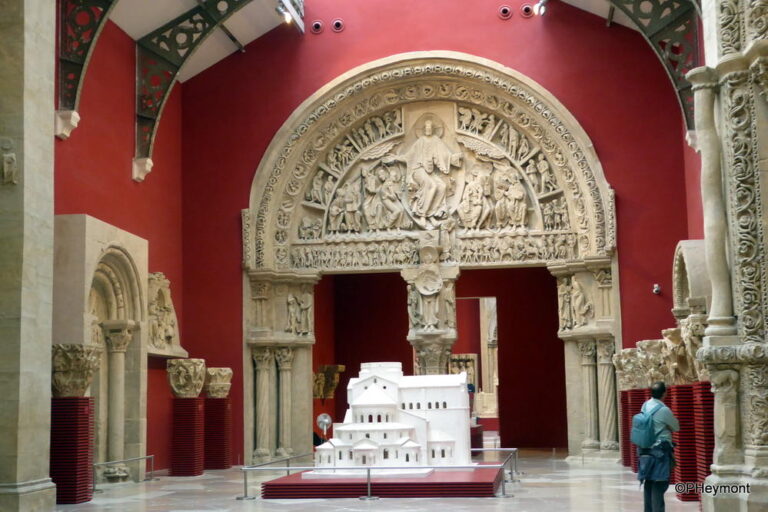

To be fair to the man, he was not alone in that idea, of recreating an idealized ‘Golden Age’ and discarding the living history of how centuries had used, adapted and, in their view, modernized the space. But what he discarded not only had immense value to its makers, it had become part of the fabric of the building, even though much was in poor condition by his time.


And that development over time is what happens to every building, important or mundane. It happens year by year in our homes; even those of us who have lived many years in a single home will have changed it significantly over time.
In Barcelona, at Sagrada Familia, we can see that happening almost in real time as Antoni Gaudi’s general plan is worked toward its completion by new generations of architects and artists.


The differences between the Nativity Facade and its sculpture, above, done under Gaudi’s direction, are quite different in style from work on the Passion facade, done by Josep Maria Subirachs, and yet they are of a piece, and at peace.


And that is exactly what Gaudi himself foresaw, and I think we’d do well to think of his words when considering what should be done with historic monuments and historic memory:
It is not a disappointment that I will not be able to finish the Temple. I will grow old, but others will come after me. This will make it even more grandiose. I know the personal taste of the architects that follow me will influence the works but that doesn’t bother me. I think the Temple will benefit from it. Great temples have never been the work of just one architect.”
Title image: An installation view of Claire Tabouret’s “In a Single Breath” at the Grand Palais, in Paris.


