

While many of Germany’s bombed churches were meticulously reconstructed after World War II, almost as if to deny anything had happened, the Saint Moritz church in Augsburg took a different tack.

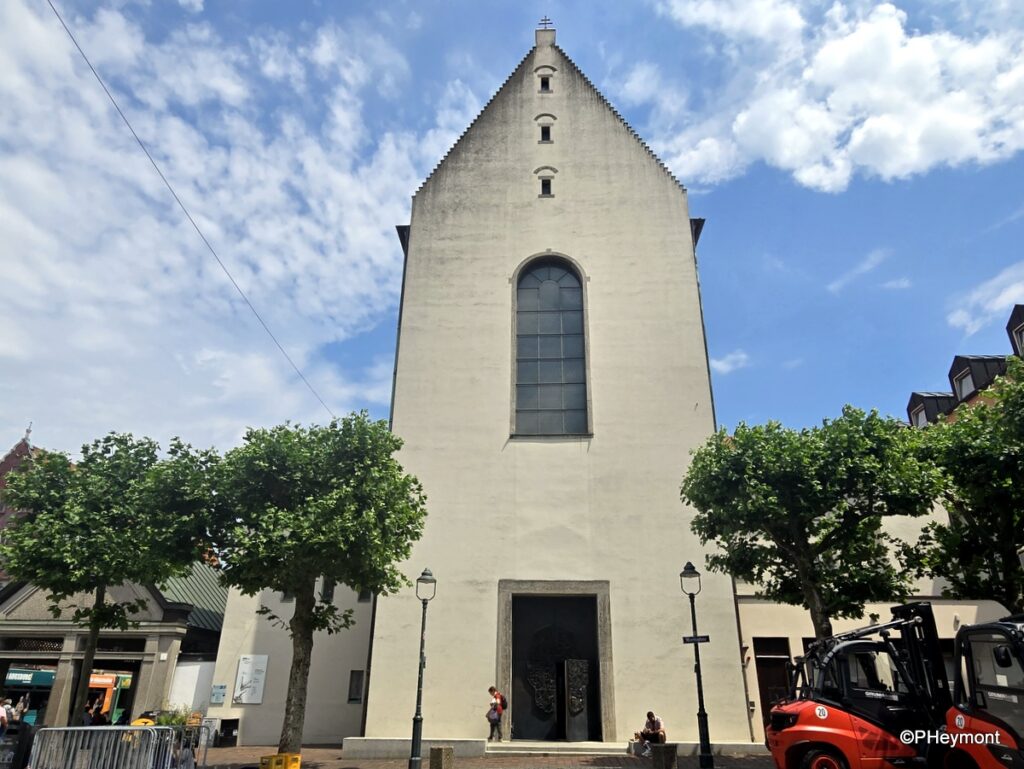
Almost completely destroyed except for parts of its outer walls, the thousand-year-old church was hastily rebuilt in a much-simplified style between 1946 and 1950 without much planning. Before the war, it had been an elaborately Baroque church, the product of a millennium of additions, redecoration and restyling.


By the beginning of the 21st century, a plan developed to redevelop and redesign, to make the interior more unified, and to prepare for a future that included Sankt Moritz becoming the home of the Augsburg Diocese’s pastoral care center for the city. And that led to the stunning church you can see in the title image.


The new design is the work of London architect John Pawson, who said he wanted to create a “church space of the future,” expressing “clarity” and “minimalism.” The redesigned church was opened in 2013. Clean forms rather than color or decor set the stage; the statuary stands out in contrast.


Remnants of the historic church remain in the form of a small number of sculptures and monuments that were in storage elsewhere during the war.


A familiar saint: Sebastian, who survived the arrows only to be beaten to death on orders of a Roman emperor.

A large new organ with sharply geometric appearance faces the altar.


The main entrance with its strongly vertical aspect houses doors with impressive sculptural elements. Just below the sculptures is a Bible quotation: “and he saw the Spirit of God descending like a dove and coming to rest on him”


On the side entrance, under the colonnade along the outside of the church, another set of door sculptures.

That colonnaded gallery, which faces an open square and fountain, was built in 1980 as a shelter and station for the city trams that stop there. It also houses a number of businesses, including a cafe that is part of the church’s outreach program.


The colonnade actually reproduces history. Many ancient churches in Europe were surrounded by merchants’ and artisans’ stalls, using the outer wall as part of their shops and paying a fee to the church. In Augsburg, this gallery sits where there was once the city’s Kornhaus, or granary.


